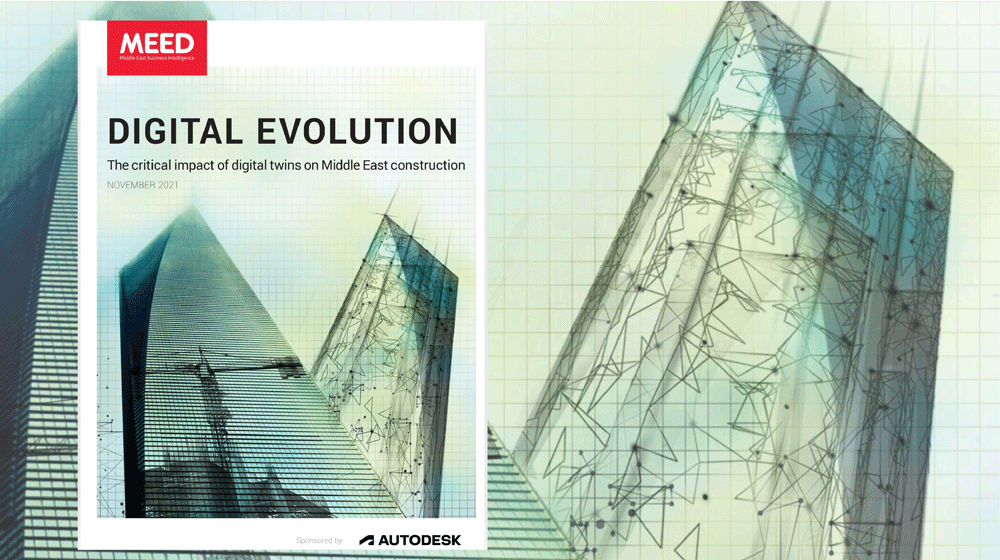
 Impact of digital twins on Middle East construction | MEEDAn exclusive report from MEED in partnership with Autodesk reveals the role of advanced digital and data technologies in innovating project delivery
The Middle East construction sector has been painfully slow to evolve and adapt its processes to take advantage of an ever-growing range of digital technologies.
Click here to download the full report
This is changing. With its potential to deliver significant savings in project delivery time, materials and costs, building information modelling (BIM) – three-dimensional digital representations of a project that can be accessed and updated by multiple stakeholders – has gained widespread acceptance in the industry.
But the digitalisation journey does not end with project delivery. Data collected from the integrated workflows and information sharing on BIM models used during the design and construction process can be layered with real-time operational data to create a ‘digital twin’ of the development.
“A digital twin not only looks like the asset, it also behaves like the real asset,” says Anas Bataw, director of the Centre of Excellence in Smart Construction (CESC) at Herriot Watt University – Dubai.
“Digital twins can provide current information on a building’s performance, its subsystems and how it is being affected by occupant behaviour.”
A two-way connection between the digital and physical asset is enabled by sensors, while advanced technologies such as artificial intelligence (AI), machine learning and the internet of things (IoT) give digital twins the capacity to learn, update and communicate with their physical counterparts by exchanging data throughout the asset’s lifecycle.
“Digital twins can also fill data gaps and make predictions on unanticipated scenarios while continuously optimising the operational performance,” says Bataw. “In essence, a digital twin is much more focused upon assets performance than a traditional BIM model.”
The potential for digital twins to enhance asset management is being recognised in the hospitality sector. Used effectively, digital twins promise to not only allow project owners and operators to ensure that their assets are running efficiently and safely, but they also ensure that users, such as guests in a hotel, workers in an office or residents in a residential development, have a smooth and seamless experience.
https://www.civilengineering.ai/impact-of-digital-twins-on-middle-east-construction/
 Future Construction Technology: A Growing Need For Construction ProfessionalsConstruction technology is a broad term meaning the science and art of building things, machines, or other forms, and also comes from Latin ad hoc and Old French construction which means “nameless”. To build is the verb, and the word for construction is construction: How a thing is constructed, the reality of its construction, whether it is man-made or organic. Modern construction technology has also come to refer to the processes used in constructing buildings, bridges, tunnels, skyscrapers, ships, aircraft, and other things: the science of the building itself; the engineering of the construction; and the construction methods themselves, such as CNC machine programming. But most commonly, construction technology refers to the tools, materials, and machinery used in building.
 Robust recovery in civil construction anticipatedThere is hope of a robust recovery in civil construction if the government can follow through on its ambitious plans to invest in large scale civil projects and incentivise the private sector, says construction market intelligence firm Industry Insight.


