

Showing posts with label INTELLIGENT TRANSPORTATION SYSTEM. Show all posts

China Tech Digest: Tencent Unveils IDC Operation Robot; Baidu Apollo To Build Intelligent Transportation In Huangpu

December 07, 2021

China Tech Digest: Tencent Unveils IDC Operation Robot; Baidu Apollo To Build Intelligent Transportation In HuangpuTencent unveils IDC operation robot


Chinese internet giant Tencent Holdings has recently unveiled its internet data center (IDC) operation robot. The robot is currently in trial operation in the Qingyuan Cloud Computing Data Center in Guangdong province, and will be applied in several IDCs of Tencent in the future. In addition, Tencent Cloud officially released a new intelligent operation management product system-Zhiwei. The IDC robot has become an important part of Tencent’s Zhiwei system. At present, Tencent Zhiwei has supported nearly 100 Tencent’s data centers around the world and served customers in telecom, Internet, finance and other industries.


Baidu Apollo to build intelligent transportation in Huangpu

Huangpu District People’s Government will have in-depth cooperation with Baidu Inc. in the construction of urban digital public base, digital government construction, and "car-city network" integrated platform. The two parties will also jointly formulate a standard system for intelligent networked vehicles in Huangpu District, build a sustainable industrial development model of "R&D-Design-Test-Demonstration-Application" to promote the development of Huangpu’s automobile industry.


GL Ventures leads series B+ round in intelligent construction solution provider RoboticPlus.AI


GL Ventures has led series B+ round of financing in Chinese intelligent construction solution provider RoboticPlus.AI. Proceeds of the round will be mainly used in product development, automatic factory system construction, and team expansion.


TrendForce: Industrial metaverse will spur global smart manufacturing market to reach US$540 billion by 2025


The concept of "Metaverse" can meet the increasing market demand of remote operations, virtual reality, and simulation operations, according to TrendForce. Intelligent manufacturing is also expected to accelerate the development of related technologies and spur global smart manufacturing market to reach US$540 billion by 2025, with a compound growth rate of 15.35% from 2021 to 2025.


(China Money Network’s articles are curated and translated from credible Chinese media organizations with established brands, experienced editorial teams, and trustworthy journalism practices. However, we are not responsible for the accuracy of the information. For any questions, please reach out to our editorial department.)
https://www.civilengineering.ai/china-tech-digest-tencent-unveils-idc-operation-robot-baidu-apollo-to-build-intelligent-transportation-in-huangpu/

WBCSD report outlines actions needed to accelerate EV charging infrastructure deployment

November 28, 2021

Report outlines actions needed to accelerate EV charging deploymentA new World Business Council for Sustainable Development report has highlighted key business and policy actions that can improve the case for sustainable EV charging infrastructure implementation.



On 10 November 2021 at COP26, the World Business Council for Sustainable Development (WBCSD) launched a new report outlining the cross-sectoral actions that are needed to accelerate the deployment of efficient electric vehicle (EV) fleets and sustainable charging infrastructure.


Developed in collaboration with Arcadis, Arval BNP Paribas Group, Eaton, EDP, Enel X, Lanxess, Mercedes-Benz AG, Microsoft, National Grid and Nederlandse Spoorwegen, the report helps businesses and policymakers understand where to invest and how to act to bridge the infrastructure gap.


The uptake of EVs is growing globally, but the current deployment pace of sustainable and inclusive charging infrastructure is insufficient to support the expected number of 350 million electric light-duty vehicles on the roads by 2030. To reach the 1.5° goal of the Paris Agreement, there is a need to rapidly increase the speed and scale of investments in charging infrastructure.
https://www.civilengineering.ai/wbcsd-report-outlines-actions-needed-to-accelerate-ev-charging-infrastructure-deployment/

Revealed: Areas with the best and worst road conditions in England

November 28, 2021
Revealed: Areas with the best and worst road conditions in England
Revealed: Areas with the best and worst road conditions in EnglandThe areas with the best and worst road conditions in Britain have been revealed.
https://www.civilengineering.ai/revealed-areas-with-the-best-and-worst-road-conditions-in-england/

Mobile ticketing launched on Osaka Monorail

November 28, 2021

Mobile ticketing launched on Osaka MonorailUsers of the Japan Transit Planner and Norikae Annai journey planning MaaS apps can now benefit from mobile ticketing when travelling on the Osaka Monorail.


Jorudan, Japan’s leading trip planning service – in partnership with Masabi – has announced the launch of mobile ticketing for Osaka Monorail, Japan’s largest elevated rail network, covering 18 stations in the country’s third largest city.


The initial three-month pilot deployment will see the two companies deployed in a major Japanese city, offering a proven mobile ticketing solution on a high-density transit service with high passenger volumes.


From 4 November 2021, passengers can purchase one-day mobile tickets and off-peak mobile tickets, valid for use across the entire network using Jorudan’s two MaaS apps – Japan Transit Planner and Norikae Annai journey planning. The Japanese company has integrated the Justride mobile ticketing SDK into its market-leading MaaS apps, meaning that, once operators sign up to the service, tickets can quickly and easily be made available to all users of both apps.
https://www.civilengineering.ai/mobile-ticketing-launched-on-osaka-monorail/

Canadian Electric Vehicle-To-Grid Project Uses Blockchain

November 27, 2021
Canadian Electric Vehicle-To-Grid Project Uses Blockchain
Canadian Electric Vehicle-To-Grid Project Uses BlockchainElectric vehicles have a number of benefits that gas-powered ones do not. To name just a few, they have zero direct toxic emissions, they produce very little road noise, they have fewer moving parts that need replacement or repairs, and in some cases their batteries can be re-purposed for second life use in stationary energy storage products. Another advantage is vehicle-to-grid technology (V2G), which allows plugged-in EVs to draw electricity from the grid and they can also send it back.



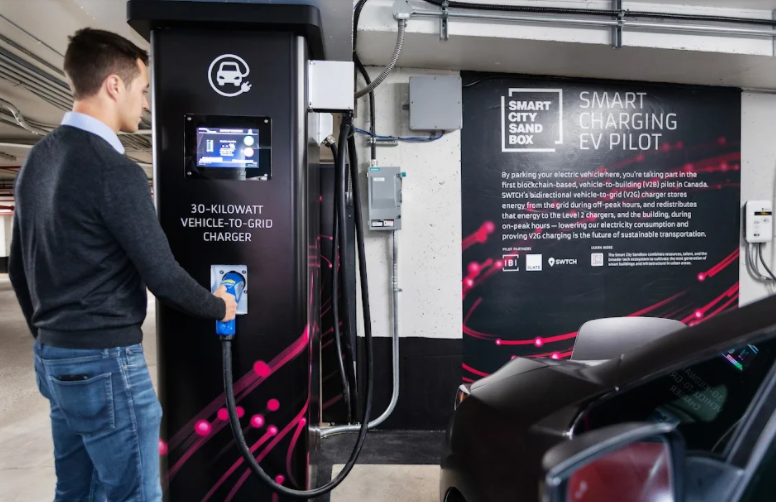
In Canada, a V2G project is using a Nissan Leaf connected to a technology platform created by SWTCH that allows electricity to flow from the Leaf’s battery to a multi-tenant building. SWTCH’s CEO, Carter Li, answered some questions about the project for CleanTechnica.


Why is the SWTCH blockchain-based, EV-to-Building pilot being conducted?


The three-year pilot demonstrates how commercial and multi-family building operators can accommodate the growing demand for EV charging stations while simultaneously improving the building’s energy efficiency and reducing building operational costs. Leveraging SWTCH’s bidirectional, vehicle-to-grid (V2G) charging technology, our pilot will explore viability of vehicle-to-grid charging technology in high-density multi-tenant buildings to store energy using EVs during off-peak hours and redistribute that energy to the building and other uni-directional EV chargers during on-peak hours. The technology and model developed by SWTCH is unique as it includes a financial incentive structure for EV owners to participate in the program which leverages blockchain technology. The SWTCH platform tracks when energy is being discharged from an EVs battery and when it’s being charged, creating a history of credits and debits securely managed through a third-party distributed ledger system that participants can monitor using their smartphones.


What are the pilot project goals?


The clean energy pilot aims to improve the electric vehicle (EV) charging access in high-density buildings by addressing the barriers to deploying EV charging infrastructure within the built environment by creating an energy distribution business model that benefits both building operators and EV owners. As electric vehicles gain popularity and adoption, the question of how to accommodate a rise in EV charging infrastructure without additional strain on building electrical infrastructure and the electrical grid becomes increasingly relevant. Vehicle-to-grid technology allows buildings to draw energy from EVs during on-peak hours rather than the grid. During the pilot, the V2G-enabled EVs will store energy during off-peak hours and redistribute that energy to the building and the EV chargers in use, creating an energy flow that is cost-effective and environmentally sustainable. The project also employs bi-directional V2G DCFC charging stations, smart unidirectional Level 2 AC charging stations, and stationary battery energy storage systems as distribute energy resource assets for demand response, peak shaving, and peer-to-peer energy trading purposes.
https://www.civilengineering.ai/canadian-electric-vehicle-to-grid-project-uses-blockchain/

Connected cars: The race for the car of the future

November 27, 2021

Connected cars: The race for the car of the futureFor Intelligent Transport, Osborne Clarke’s Arty Rajendra and Matthew White consider how connected technologies are disrupting the automotive industry and discuss what the future of car connectivity may look like, as well as outline the legal challenges that are being faced by the sector in this field.



Over the past 10 years, the automotive industry has gone through a period of immense upheaval. Traditional business models, supply chains and incumbent market players are all being challenged by a wave of new entrants that are shaking up the market.


This upheaval has been caused by several trends affecting the industry, including the emergence of autonomous vehicles, growth in shared mobility and the electrification of the vehicle network. While each of these has played a major role in unsettling the market, the greatest disruption can probably be attributed to another trend: connective technology. Whether fully or semi-autonomous, hybrid or electric, shared or personal, connectivity is expected to be the defining feature of ‘the car of the future’.


The fully connected car will be made up of an ecosystem of connected technologies which will enable it to transfer and process large amounts of data while travelling at high-speed. The ability to communicate a substantial volume of information bi-directionally is necessary to support the two main pillars of connectivity: infotainment and infrastructure.
https://www.civilengineering.ai/connected-cars-the-race-for-the-car-of-the-future/

SmartConnect delivers how-to information for practitioners deploying smart building technologies

November 27, 2021

SmartConnect delivers how-to information for practitioners deploying smart building technologiesLEDs Magazine colleagues at Smart Buildings Technology will hold a day-long virtual event on Nov. 17, 2021, with the “SmartConnect” event program beginning at 10:30 AM ET. The online learning opportunity will feature technical presentations that delve into connected lighting, security concerns, wireless infrastructure, the Internet of Things (IoT) and its role in building connectivity, and network physical-layer infrastructure.


As written earlier this summer, Smart Buildings Technology was launched in 2021 to cover technologies, building design, and applications in smart buildings from an integration and information/operations technology (IT/OT) professional vantage point, delivering actionable intel on the growing market, wired and wireless networking technologies, building equipment and management, and more for the deployment of advanced systems into intelligent buildings.


Smart Buildings Technology chief editor Patrick McLaughlin will keynote the event, outlining recent findings from the organization’s first business intelligence report in collaboration with Endeavor Business Media’s Strategies Unlimited market research arm in a presentation called “A 3D Look at the Smart Buildings Market: Directions, Drivers, and Dynamics.”


The report, titled “Smart Building Technology Adoption,” provides information and statistics on the use of intelligent systems in commercial and institutional properties. Learn more and purchase the full report at the Strategies Unlimited website.


During SmartConnect, presenters from companies such as Future Electronics, ABB, AEM, Belden, and Assa Abloy Opening Solutions will discuss topics ranging from Bluetooth mesh networking to 5G and wireless connectivity and other solutions for smart buildings. Representatives from the Telecommunications Industry Association (TIA) and Underwriters Laboratories (UL) will summarize the market drivers that are pushing industry standards and certification bodies to develop benchmarking and assessment criteria for intelligent building equipment and whole systems transformation to prepare for future connectivity and data-driven operations across commercial, institutional, and industrial settings.


The day-long SmartConnect virtual program is free to attend and will be archived on demand for 90 days after the conclusion of the live presentations. Register now to attend SmartConnect and gain access to a knowledge base that spans building infrastructure, information, and integration roles.


CARRIE MEADOWS is associate editor of LEDs Magazine, with 20 years’ experience in business-to-business publishing across technology markets including solid-state technology manufacturing, fiberoptic communications, machine vision, lasers and photonics, and LEDs and lighting.
https://www.civilengineering.ai/smartconnect-delivers-how-to-information-for-practitioners-deploying-smart-building-technologies/

Hisense Plans to Acquire Siemens Intelligent Traffic Systems

November 26, 2021

Hisense Plans to Acquire Siemens Intelligent Traffic Systems - PandailyChinese home appliance maker Hisense planned to invest nearly $1 billion to acquire Siemens’ Intelligent Traffic Systems (ITS), 21st Century Business Herald reported on Wednesday. Hisense has not responded to the report.


In November, Siemens announced it was splitting its ITS division into a separate company. Subsequently, many media outlets reported that Siemens was planning to divest its the transportation business in 2021, which was expected to involve more than 40 countries and regions.


According to public information, Siemens Mobility has a history of more than 100 years. It offers intelligent and efficient mobility solutions for urban, intercity and freight transportation.


Siemens ITS, belonging to Siemens Mobility, mainly provides intelligent solutions for improving mobility on roads and in cities, with annual revenue exceeding 600 million euros ($678.8 million) and has been maintaining steady growth.


SEE ALSO: China’s High-Speed Rail and the Global Push for Green Transit


Zhang Sihai, President of Hisense TransTech, revealed earlier in an interview that Hisense’s intelligent transportation sector is also actively expanding overseas. The acquisition of Siemens ITS, therefore, will bring more opportunities for its overseas expansion.


According to data released by Chinese transportation inquiry platform 7its.com, Hisense ranked first in the total order scale of city-based smart transportation products from 2011 to 2020. At present, Hisense intelligent transportation products and solutions have been deployed in more than 169 cities throughout China.
https://www.civilengineering.ai/hisense-plans-to-acquire-siemens-intelligent-traffic-systems/
 
Copyright © Ai4civilengineering