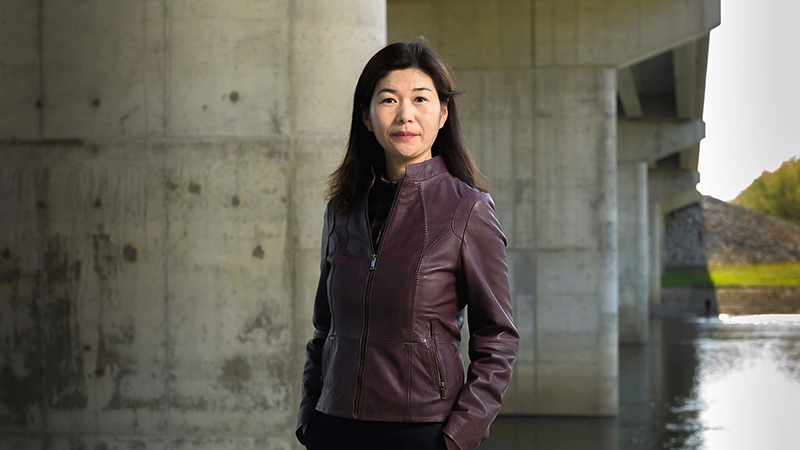
Expert: Holiday traffic jams could be prevented by ‘smart concrete’THANKSGIVING TRAVEL: As an expected 13% more Americans prepare to travel for Thanksgiving this year, construction on major interstates could leave millions in traffic jams. Purdue University civil engineering professor Luna Lu can discuss how her research is working to cut down on road repairs and traffic through the development of “smart concrete.”
“Traffic jams caused by infrastructure repairs have wasted four billion hours and three billion gallons of gas on a yearly basis. This is primarily due to insufficient knowledge and understanding of our infrastructure’s condition,” Lu says. “For instance, we don’t know when concrete will reach the right strength needed for opening up major roads to traffic after construction. In many states, major interstates need to reopen in a 12-hour window, which only leaves three to four hours for concrete to cure. The concrete may go through premature failure, leading to frequent repairing.”
SMART CONCRETE: Lu and her students have invented technology that addresses two big challenges in road construction: figuring out exactly when concrete is strong enough to handle heavy traffic and improving the durability of concrete. In reducing the frequency of road repairs, these inventions could also save millions of taxpayer dollars.
Road sensors: To better communicate with concrete, Lu’s lab has developed sensors that wirelessly track concrete strength development in real time, giving engineers more precise data on how much time is needed before traffic can use new concrete pavement. In 2019, the Indiana Department of Transportation began embedding these sensors in Indiana highways. Lu has also been working with the Federal Highway Administration to embed the sensors in other states, including California, Texas, Missouri, Tennessee, Colorado and North Dakota.
Self-healing concrete: Harsh winters can cause concrete to crack. Lu’s lab discovered that mixing nano-silica materials into concrete can help the mixture to seal its own cracks while regaining strength. The healing process also prevents water from seeping into the concrete and corroding steel or rebar reinforcement.
NEXT UP – SMART ASPHALT AND SOIL: Lu’s research currently applies to concrete, the most challenging road material to repair, but could resolve issues with other road materials in the future.
“Like with concrete, we can understand the conditions of strength for materials such as asphalt and soil, and use that information to determine traffic opening time,” Lu says.
VIDEO: A video of Lu discussing how her research could improve roads has been uploaded to the AP Video Hub. All videos in the Campus Insights series are free for download and use by AP members at apvideohub.ap.org or by doing a general search on the Associated Press site or AP Newsroom. AP members can use the video or pull quotes for a print article, broadcast or podcast.
About Purdue University
Purdue University is a top public research institution developing practical solutions to today’s toughest challenges. Ranked in each of the last four years as one of the 10 Most Innovative universities in the United States by U.S. News & World Report, Purdue delivers world-changing research and out-of-this-world discovery. Committed to hands-on and online, real-world learning, Purdue offers a transformative education to all. Committed to affordability and accessibility, Purdue has frozen tuition and most fees at 2012-13 levels, enabling more students than ever to graduate debt-free. See how Purdue never stops in the persistent pursuit of the next giant leap at https://purdue.edu/.
Writer, Media contact: Kayla Wiles, 765-494-2432, wiles5@purdue.edu
Source: Luna Lu, luna@purdue.edu
https://www.civilengineering.ai/expert-holiday-traffic-jams-could-be-prevented-by-smart-concrete/

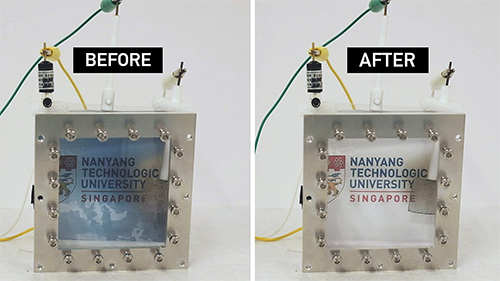
 Scientists invent ‘smart’ window material that blocks rays without blocking views(Nanowerk News) An international research team led by scientists from Nanyang Technological University, Singapore (NTU Singapore) has invented a ‘smart’ window material that controls heat transmission without blocking views, which could help cut the energy required to cool and heat buildings.


